

Last Updated: October 28, 2026
Quick Summary
Authentic handmade holy land olive wood comes from olive trees grown in the Bethlehem and Jerusalem regions and is carved by local Christian artisans. You can verify it by checking five signals: natural grain variation, dense weight, visible tool marks, origin documentation, and a natural oil or wax finish.
- Real olive wood varies in grain, color, and weight from piece to piece, so uniformity is a red flag.
- A certificate without a named workshop, location, or carver's signature is decoration, not proof.
- Hand-carved crosses show slight asymmetry and tool marks rather than perfectly uniform, sanded surfaces.
- Care for pieces by dusting with a dry cloth and oiling lightly once or twice a year.
- Ask sellers where the wood was sourced, who carved it, and what the shipping and return terms are.
Table of Contents
- Why Holy Land Olive Wood Carries More Than Craftsmanship
- How to Identify Authentic Olive Wood: A Buyer's Checklist
- The Handmade Olive Wood Cross: What Carving Marks Reveal
- Inside a Holy Land Olive Wood Nativity Set
- Olive Wood Care Instructions for Keepsakes That Last
- Sourcing, Sustainability, and What Fair Pricing Looks Like
- Choosing Your Piece from Yolia's Holy Land Collection
- Frequently Asked Questions
Why Holy Land Olive Wood Carries More Than Craftsmanship
Here's the part most buying guides skip. The olive tree itself is central to the story.
Below, we'll show you exactly how to tell real Holy Land olive wood from convincing imitations, and how to care for a piece so it lasts for decades.
If you want the wider context on why these pieces matter in a home, our guide on why buy artisanal religious home decor explains the tradition behind the craft.
How to Identify Authentic Olive Wood: A Buyer's Checklist
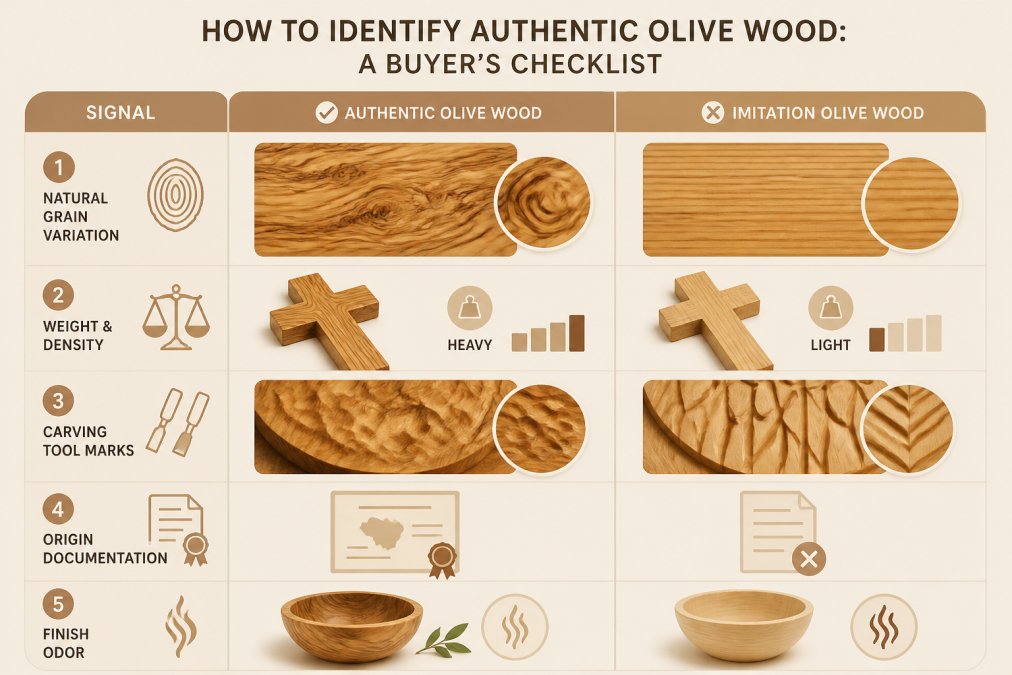
The most reliable sign of authentic olive wood is inconsistency. Real olive wood varies in grain, color, and weight from piece to piece because no two trees are alike. Uniformity is the red flag.
A practical authenticity checklist covers five signals: natural grain variation, weight and density, visible carving tool marks, origin documentation, and the smell and finish of the wood. A piece that passes all five is very likely genuine. A piece that fails two or more deserves scrutiny.
Grain, Color, and Weight Tell the Story
Olive wood has a distinctive grain: swirling, interlocking, and often darker than the surrounding wood. Color ranges from honey gold to deep brown, sometimes with streaks of near-black. If every piece in a listing looks identical, you're probably looking at stained or printed wood.
Weight matters too. Olive wood is dense and heavy for its size (Olive). A small cross should feel substantial in the hand, not light and hollow.
Documents and Origin Cues That Matter
Ask what documentation comes with the piece. Reputable sellers can describe where the wood was sourced and who carved it. Vague claims like "direct from the Holy Land" mean little without detail.
Watch out: a certificate with no named workshop, no location, and no carver's signature is decoration, not proof. Ask for specifics before you buy. A useful exercise is to request the name of the workshop and the town where it operates. If the seller cannot provide that, the claim of Holy Land origin is unsubstantiated.
A Step-by-Step Verification Routine
To make the checklist actionable, follow this sequence before you commit to a purchase:
- Inspect the grain. Look for swirling, interlocking patterns that differ from piece to piece. Uniform, repeating grain suggests a synthetic or stained substitute.
- Weigh it in your hand. Olive wood is dense; a piece that feels light or hollow for its size is suspect.
- Look for tool marks. Hand-carved pieces often show subtle ridges, slight asymmetry, or chisel marks in recessed areas. Perfectly smooth, uniform surfaces may indicate machine production.
- Ask for origin details. Request the workshop name, location, and carver information. A certificate without these specifics is not proof.
- Check the finish and smell. Artisans typically use natural oils or waxes. A strong chemical odor or a heavy, plastic-like coating is a warning sign.
Red Flags That Deserve Extra Scrutiny
Beyond the five signals, certain patterns should prompt caution. Be wary of sellers who cannot name the workshop or region, who use generic phrases like "authentic Holy Land olive wood" without any supporting detail, or who offer certificates that lack a carver's signature or workshop address. Also treat unusually low prices with suspicion: hand-carving takes hours, and a price that seems too good to be true often reflects machine production or a different wood species.
If you want to see how these signals apply to real pieces, browse our Christian religious gifts and jewelry and compare the grain and finish across items. Each piece in our Holy Land collection is selected with these authenticity markers in mind.
Here is the five-signal checklist the article recommends running through before you commit to a purchase.
| Signal | What to look for | Warning sign |
|---|---|---|
| Grain | Swirling, interlocking patterns that differ per piece | Uniform, repeating grain |
| Weight | Dense and heavy for its size | Light or hollow feel |
| Tool marks | Subtle ridges, slight asymmetry, chisel marks | Perfectly smooth, uniform surfaces |
| Origin details | Workshop name, location, carver information | Certificate with no named workshop or signature |
| Finish and smell | Natural oils or waxes | Strong chemical odor, plastic-like coating |
The Handmade Olive Wood Cross: What Carving Marks Reveal
A handmade olive wood cross shows evidence of the hand that made it. Look for slight asymmetry, tool marks in the recessed areas, and small variations in depth between the arms.
Mass-produced crosses are sanded to perfect symmetry and uniform depth. Hand-carved pieces rarely are. Run your fingertip along the edges: a handmade cross often has subtle ridges where the blade passed.
What most guides miss is the finish. Artisans typically use natural oils or waxes rather than heavy lacquer, which preserves the wood's texture and smell. A strong chemical odor is a warning sign.
Inside a Holy Land Olive Wood Nativity Set
When evaluating a set, check the faces and hands first. These are the hardest parts to carve and the easiest places to spot machine work. Hand-carved faces have small irregularities and distinct expressions.
Set composition varies. Some include the Holy Family alone; others add shepherds, angels, or animals. Ask what's included before ordering so the set matches your space and tradition.
Olive Wood Care Instructions for Keepsakes That Last
Olive wood care is simple: keep it away from prolonged moisture, direct heat, and harsh sunlight, and oil it lightly once or twice a year. Treated well, a carved piece can stay beautiful for generations.
Follow these care instructions:
- Dust with a soft, dry cloth rather than a wet one
- Keep pieces out of direct sunlight to prevent fading and cracking
- Avoid dishwashers, soaking, and harsh cleaning sprays
- Apply a thin coat of food-safe mineral oil or beeswax to kitchenware and occasionally to decorative pieces
- Store in a dry space, not a damp basement or attic
- Handle with clean hands, since oils and dirt settle into open grain
A common mistake is over-oiling. A light coat, buffed off after a few minutes, is enough. Too much oil leaves a sticky surface that attracts dust.
Sourcing, Sustainability, and What Fair Pricing Looks Like
Sustainability in olive wood comes down to how the wood is obtained. Genuine workshops typically use wood from trees that have stopped fruiting or been pruned, rather than felling productive trees. Ask sellers how they source their raw stock, and treat vague answers as a caution.
A common pattern among responsible workshops is to explain the harvest cycle: olive trees are pruned annually, and the cut branches are collected for carving. Older trees that no longer bear fruit may also be removed and used. This approach avoids waste and preserves the productive groves.
What Responsible Sourcing Claims Actually Mean
Terms like "sustainable," "ethical," and "fair trade" are often used loosely. To evaluate a claim, ask what specific practice it refers to. Does the seller name the workshop and the region? Can they explain how the wood is harvested? Do they mention the artisans by name or describe the working relationship? A claim that cannot be tied to a concrete practice is marketing language, not a sourcing guarantee.
Fair Pricing: What You Are Actually Paying For
Check our collection pages for current details rather than rely on general figures.
Buying Risks, Shipping, and Returns
Buying risks worth knowing: shipping delays around peak gift seasons, customs handling for international orders, and return windows that vary by seller. Confirm shipping timelines and return terms before a milestone gift like a Baptism or First Communion.
International orders may also involve customs fees or import duties, which are typically the buyer's responsibility. Ask the seller how they handle damaged or lost shipments, and whether they provide tracking. Before purchasing, verify the seller's return policy in writing, including who pays for return shipping.
If you are ready to explore pieces selected with these sourcing and purchasing considerations in mind, browse our Christian religious gifts and jewelry to see the current collection.
Choosing Your Piece from Yolia's Holy Land Collection
Start with the purpose. A cross or rosary suits personal devotion and daily prayer. A nativity set anchors a home during Advent. A small carved keepsake works as a Baptism or Confirmation gift. Matching the piece to the occasion narrows the choice quickly.
Then check the details that signal quality: grain variation, carving marks, finish, and origin information. If you're buying online, our guide on how to choose artisan made Christian gifts online walks through the questions to ask before checkout. You can browse our Christian religious gifts and jewelry to see the pieces currently available.
Frequently Asked Questions
How can you tell if Holy Land olive wood is authentic?
Look for natural grain variation, since no two pieces of holy land olive wood look alike. Authentic pieces feel dense for their size and show fine tool marks from hand carving. Ask the seller for origin details and how the wood was sourced. A uniform pattern, a painted-on grain, or a suspiciously light weight are warning signs. Reputable sellers explain their sourcing openly rather than relying on a single sticker.
Are Holy Land olive wood items handmade?
Many are, especially crosses, nativity figures, and rosaries carved in family workshops around Bethlehem. Handmade pieces carry small irregularities: slightly uneven edges, visible chisel marks, and grain that follows the shape rather than a template. Mass-produced copies tend to look identical to one another. When you shop, ask whether the item is hand-carved and check photos for those small signs of an artisan's hand.
How should you care for olive wood religious gifts?
Keep olive wood away from direct sunlight, radiators, and damp rooms, because rapid moisture changes can cause cracking. Dust with a soft dry cloth and avoid soaking or dishwashing. A light application of food-safe oil once or twice a year, buffed off afterwards, helps preserve the finish on items like crosses and nativity sets. Store seasonal pieces wrapped in breathable cloth rather than sealed plastic.
Why is olive wood significant in Christian gifts?
Olive trees have grown in the Holy Land for thousands of years and appear throughout Scripture, from the Mount of Olives to the story of Noah's dove. Wood from these trees links a gift to Bethlehem and the Christian story, which is why crosses, nativity sets, and rosaries carved from it are given for Baptisms, First Communions, and Confirmations. The natural grain also makes each keepsake one of a kind.
The hardest part of buying Holy Land olive wood is trusting what you can't touch. We built Yolia's collection around pieces we can describe honestly: where the wood comes from, how it's carved, and how to care for it. Explore our faith-inspired gifts and jewelry, take your time with the details, and choose a keepsake made to be passed down. Get started with Yolia and find a piece that carries both craft and meaning.
